.png)
Competitive Cultural Shifts: Evolving the Modern Field Team

Introduction: The New Competitive Reality
Standing out in healthcare has always been difficult. Today, it is structurally harder.
Healthcare decision-making has evolved into a complex, multi-variable system shaped by workforce shortages, financial pressure, regulatory uncertainty, and shifting care models. These forces are not theoretical. They are actively reshaping how decisions are made across the ecosystem.
The scale of system strain is significant. The U.S. healthcare sector employs nearly 18 million people, yet 92 million Americans live in primary care shortage areas, highlighting a widening gap between demand and access.

At the same time, healthcare leaders are navigating increasing uncertainty. In Deloitte’s 2026 Global Health Care Outlook, executives identified workforce challenges, financial pressure, and regulatory complexity as defining forces shaping strategy.
These pressures are compounded by structural transformation.
Over 40% of healthcare executives report that care delivery transformation will directly impact their strategy in 2026, signaling a shift away from traditional models.
The implication is clear. The environment in which field teams operate is more complex, constrained, and dynamic than at any point in recent history.
Competitive advantage no longer comes from better messaging alone. It comes from better thinking. Field teams must evolve from messengers to strategic operators within complex systems.
Strategic Thinking Drives Competitive Performance

The modern representative operates in ambiguity. No two customers are alike, and no single narrative works across stakeholders.
This is not simply a commercial shift. It reflects deeper system dynamics. Healthcare organizations are under pressure to rethink how care is delivered, who delivers it, and how resources are allocated.
In this environment, success depends on the ability to interpret complexity and act on it.
From Messaging to Diagnosis
High-performing reps now act less like presenters and more like analysts.
They must:

Interpret fragmented stakeholder needs

Identify clinical, economic, and operational decision drivers

Adapt engagement strategies in real time
That requires strategic thinking.
In practice, that means the ability to:
Diagnose a customer environment
Prioritize opportunities within that environment
Select the right combination of tools, content, and engagement approaches
Strategic Thinking is a Trainable Capability
Despite its importance, many organizations still treat strategic thinking as innate.
That approach does not hold up under scrutiny.
Organizations that fail to align capability building with business strategy struggle to translate training into impact. Industry leaders continue to highlight that L&D alignment remains a persistent gap across industries, limiting the effectiveness of capability development efforts.
Strategic thinking behaves like a muscle. It improves with structured practice, applied tools, and reinforcement in real-world scenarios.
Culture Must Reinforce the Shift
Training alone is insufficient. Strategic capability requires cultural alignment.
Three conditions are critical:
Leadership alignment: Leaders must define what effective decision-making looks like in the field
Manager enablement: First-line managers must coach to strategy, not just activity
System reinforcement: Metrics and incentives must reward decision quality

Without these elements, organizations revert to transactional execution.
Applying Competitive Insight to Strategic Decision-Making
In competitive markets, information is abundant. The challenge is not access. It is application.
Competitive intelligence has traditionally been used to refine messaging. That approach is too narrow for today’s environment.
It should inform decision-making.

From Knowledge to Action
Effective field teams use competitive insight to answer critical questions:
Where does our solution create differentiated value in this specific context?
Which stakeholders are most influenced by competitor positioning?
What barriers exist that competitors cannot address?
This shift reflects a broader transformation across healthcare. Leaders are moving toward more data-driven, context-specific decision-making models, supported by digital and analytical tools.
The Risk Dimension: Why Guardrails Matter
Greater autonomy introduces greater risk.
Field teams must clearly understand:
What competitive data can be used
How it can be interpreted
Where compliance boundaries exist
In a highly regulated industry, clear guardrails are essential.
Decision Making as a Core Capability
A competitive field team is one that makes decisions consistently and effectively.
These decisions include:
Prioritizing opportunities
Positioning value within constraints
Adjusting strategies based on feedback
They happen in real time, often with incomplete information.
The role of L&D is to prepare teams for this reality.
Building Competitive Capability Through Continuous Development

Traditional training models assume predictability. They attempt to prepare reps for predefined scenarios.
That assumption no longer holds.
Healthcare ecosystems are evolving rapidly. Financial constraints, workforce shortages, and technological transformation are forcing continuous adaptation.
Static knowledge loses relevance quickly.
The Limits of Scenario Based Training
Scenario-based training remains valuable. It cannot cover the full range of real-world complexity.
Field teams routinely encounter:
New stakeholder dynamics
Unexpected access barriers
Changing institutional priorities
No finite set of scenarios can fully prepare them.
Building Adaptive Capability
Organizations must shift from knowledge transfer to capability development.
This includes:
Pattern recognition: Identifying common structures across different situations
Decision frameworks: Guiding thinking without prescribing actions
Reflection loops: Reinforcing learning through feedback and iteration
These elements enable reps to interpret and respond to new situations effectively.
Learning in the Flow of Work
Learning must move closer to execution.
Healthcare leaders are investing in digital and AI-enabled tools to improve operations and decision-making, yet adoption remains uneven. Many organizations are still experimenting rather than scaling these capabilities.
This creates an opportunity to embed learning directly into workflows through:
Just-in-time enablement
AI-supported coaching
Real-time performance insights
Learning becomes continuous rather than episodic.
The Role of Data and Feedback
Data is essential for sustaining competitive capability.
Organizations can leverage:
Engagement data to assess effectiveness
Customer feedback to refine strategies
Performance metrics to identify capability gaps
However, many organizations struggle to translate insight into action.
Closing this gap is critical to maintaining competitiveness.
Implications for L&D and Commercial Leadership

The shift toward competitive field teams has clear implications.
Redefine Capability Models
Expand beyond knowledge and communication to include:
Strategic diagnosis
Decision-making under uncertainty
Competitive application
Integrate L&D with Business Strategy
Capability building must align directly with commercial priorities.
Invest in Manager Capability
Managers are the primary drivers of behavior change and must be equipped to coach effectively.
Establish Clear Guardrails
Define:
Acceptable use of competitive information
Compliance boundaries
Decision-making authority
Build for Adaptability
The goal is adaptability in unfamiliar situations, not perfection in known ones.
Conclusion: Competitiveness as an Organizational Capability
Competitiveness is not an individual trait. It is an organizational capability.
It emerges from the interaction of strategy, culture, capability, and systems.
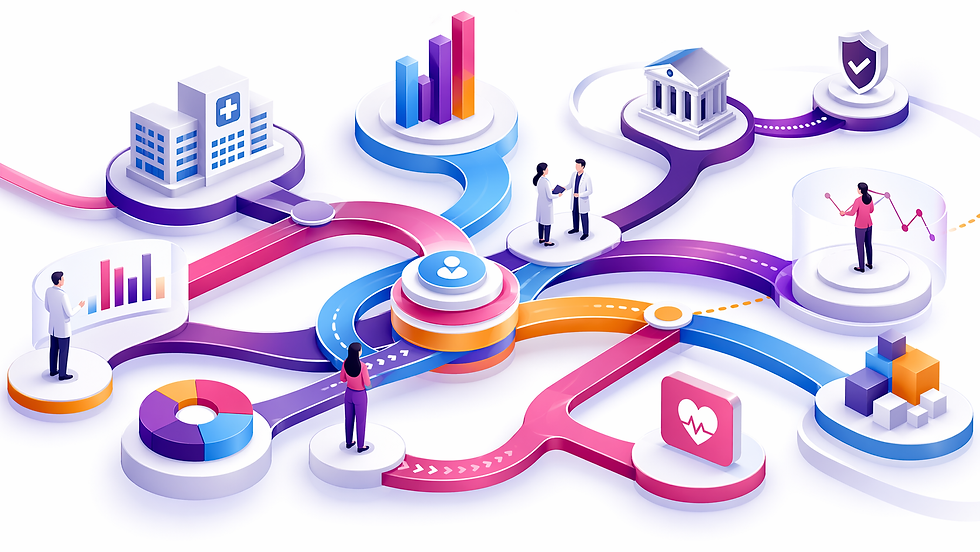
Field teams operate at the center of this system. Their ability to think, decide, and adapt determines how effectively organizations navigate complexity.

The environment will continue to evolve. A global shortage of at least 10 million healthcare workers is projected by 2030, reinforcing long-term structural pressure on care delivery and decision-making.
At the same time, financial strain, regulatory uncertainty, and care model transformation will continue to reshape the competitive landscape.
Organizations that invest in strategic capability will be better positioned to compete.
Those that do not will find it increasingly difficult to differentiate.


Comments